
It’s no big secret that China represents an extremely lucrative market for game developers. It’s estimated that more than 700 million people play games in China, and that market alone can generate as much as $50 billion in annual revenue. Mobile gaming hits especially hard in China, with up to 70% of the audience gaming on the go.
But for all the inherent value of the Chinese gaming space, it seems that Western developers just aren’t aware of how things work there. That’s despite 80% of all developers planning to release a game in China by 2028.
In a recent study, the pitfalls of Western developers planning to expand into the Chinese market were revealed.
Breaking Into China
Many of us fully understand the difficulties of getting into the Chinese gaming market. Some blockers have manifested over the years, with entirely new versions of games needing to be built to accommodate the nuances of the region. For instance, the likes of PUBG Mobile, Minecraft, VALORANT, and ARC Raiders have all stood up versions of their games that apply only to China.
And that’s only naming a very select few out of a long list.
Even some of the most important games in the business have a hard time landing in China because of regulatory walls and the need to be certified via what can often be very restrictive channels. For instance, Grand Theft Auto 5 has never been officially released in China.
But in a recent study by Rokky, a game distribution platform and publisher, it was revealed that up to 80% of developers want to launch a game in China by 2028. This information was gathered from a survey featuring 300 developers spread between North American and the United Kingdom.
In fact, China is the third most popular region for launch prioritization for Western studios, and 49.5% of respondents have already launched a title in China within the last five years.
But that doesn’t mean they all understand the region.
For instance, 43% of developers feel that ‘perceived partnership barriers’ block them from publishing their games in China, while 38% fear IP theft or piracy localized to China. In the poll, 32% of respondents felt that they didn’t understand marketing to local audiences in China, while 11% had no idea how licensing worked in the country.
In one segment, almost half of all developers felt that you could not launch a game in China without partnering with a local Chinese organization, adding another layer of complexity and locking out some smaller studios.
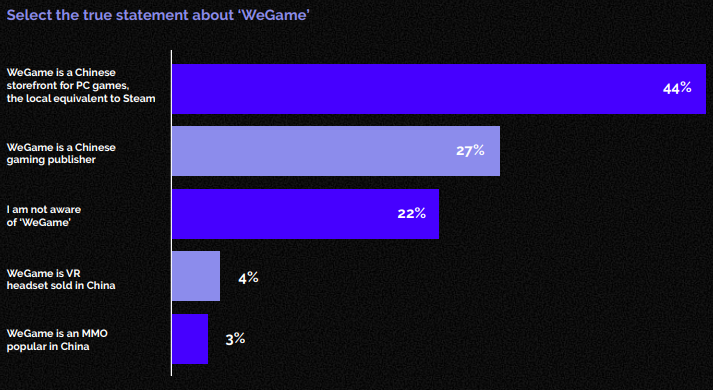
Even how games are bought and distributed in China became a point of contention and confusion. Only 44% of developers could identify WeGame, a digital Chinese storefront akin to Steam. In the survey, 27% of developers polled thought WeGame was a Chinese publisher.
The complexities don’t end there, of course. The Great Firewall of China prevents many Western applications and platforms from even surfacing in the country, which means that traditional methods of marketing and propagating a video game are off the table. For instance, Google Ads is entirely blocked from operating in China, and a fair few developers don’t understand how to promote their products in the country.
Networking and simply playing games are more facets. Many developers believe that Chinese gamers use VPNs to purchase their games from the international version of Steam, but the reality is a different picture. Mostly, it’s a case of Chinese users leaning on ‘game booster’ services to connect to overseas servers, outside of China.
Rokky’s report summed things up perfectly:
Our data shows that Western developers clearly see the appeal of Eastward expansion. Driven by the prospect of immense unit sales and an audience perceived as highly tolerant of in-game spending, studios are eager to tap into this potential.
However, key knowledge gaps around distribution and marketing platforms show that studios may underestimate the bespoke work required to enter the market. Copying and pasting Western distribution and marketing strategies will do little to appeal to China’s specialized gaming market.
And things are starting to more commonly go the other way. We’re seeing increasing numbers of Chinese studios want to market their games more prominently to the Western market. For instance, Eclipse Glow’s Tides of Annihilation is being actively developed with a Western audience in mind.
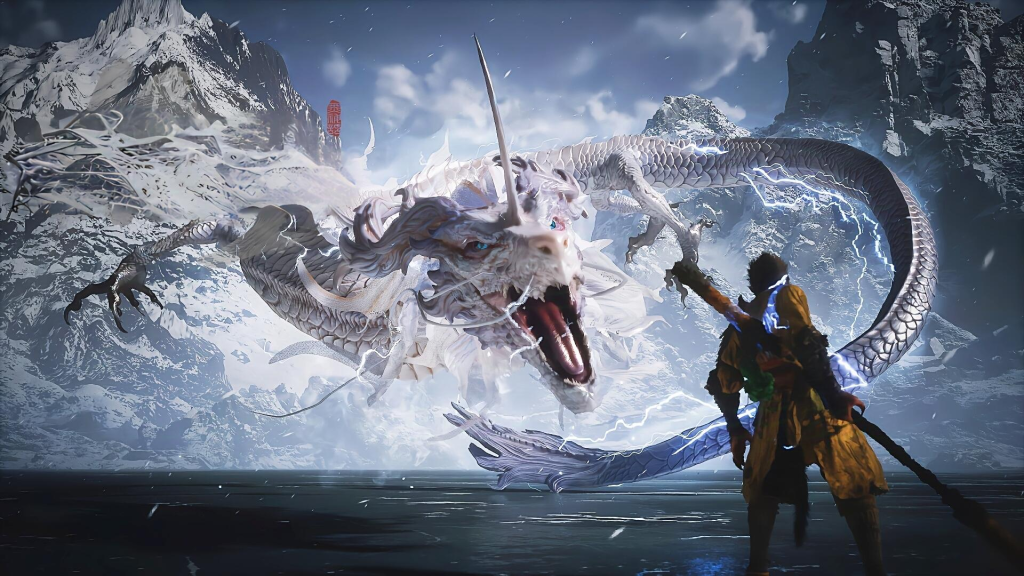
Games like Arena Breakout, Genshin Impact, Black Myth: Wukong, Wuchang: Fallen Feathers, The Defiant, and Blood Message are all coming (or have come) out of China with impressive levels of quality and high-budget production pipelines.
Do you think the East-to-West (or vice versa) relationship and ecosystem needs a lot of improving before it can flourish in the gaming space? Let us know your thoughts on the Insider Gaming Discord server.
For more Insider Gaming coverage, check out the news that a recent Star Citizen stream went awry, and don’t forget to sign up for our weekly newsletter

Grant has been gaming for 30+ years and in the industry for 10+. You’ll probably find him playing a post-apocalyptic game or an extraction shooter somewhere.
More from Grant Taylor-Hill
MOBILE APP
Level Up Your Gaming News
Real-time news, exclusive podcasts, push alerts, and a better reading experience.
Available on iOS & Android

Comments
[gs-fb-comments]